
Nano dispersion is one of the most critical process steps in advanced material development. Whether preparing lithium battery electrode slurries, electronic ceramic powders, pharmaceutical nanoparticles, conductive silver paste, or other high-performance materials, the final product quality depends heavily on particle size, distribution uniformity, contamination control, and batch-to-batch stability.
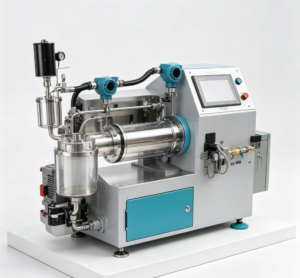
The horizontal pin-type nano bead mill is designed for ultra-fine wet grinding and dispersion. Compared with conventional grinding equipment, it uses a horizontal cylinder structure and pin rotor system to deliver higher grinding energy, better media circulation, and more consistent results. This makes it especially suitable for laboratories, research institutions, and small-scale pilot production that require precise particle size control.
Key Advantages
1. Ultra-Fine Particle Size and Narrow Distribution
Horizontal pin-type nano bead mills can achieve D50 particle sizes ranging from 20 nm to 300 nm, depending on material properties, slurry formulation, grinding media, and process parameters. Many applications can reach a narrow particle size distribution with D90/D10 ≤ 1.3, meaning the output powder or slurry is more homogeneous.
This level of control is particularly important for lithium battery materials. Inconsistent particle size can affect coating uniformity, electrochemical performance, and cycle stability. By producing finer and more uniform particles, the mill helps support higher material consistency during R&D and scale-up.
2. High Energy Pin Rotor Design
The pin rotor structure is one of the core technical features of this equipment. Pins mounted on the rotor generate strong shear, impact, and centrifugal forces inside the grinding chamber. This energy breaks down agglomerates and disperses nanoparticles more effectively than traditional bead mills.
At the same time, the horizontal layout helps optimize bead distribution and reduces sedimentation issues for high-density materials. The result is improved grinding efficiency, shorter processing time, and better repeatability from batch to batch.
3. Precision Temperature Control for Heat-Sensitive Materials
Many nano materials, electronic ceramics, and pharmaceutical compounds are sensitive to temperature changes. If grinding heat is not controlled properly, material structure, crystal phase, or chemical stability can be damaged.
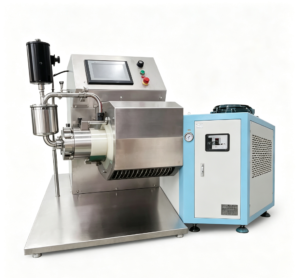
This type of nano bead mill is usually equipped with a dual-channel water cooling system that maintains stable temperature control within approximately ±1°C. By continuously removing heat from the grinding chamber, it prevents overheating and protects sensitive materials during long grinding processes. This feature is essential for maintaining product quality and avoiding thermal degradation.
4. Low Contamination Design
Contamination control is a major concern in nano material research, especially for battery materials and electronic ceramics where metallic impurities can directly affect performance. High-quality horizontal pin-type nano bead mills often use SUS316L stainless steel for parts in contact with the material, combined with a full ceramic inner chamber or ceramic-lined structure.
This design minimizes metal ion introduction and reduces magnetic impurities to very low levels, sometimes down to 50 ppb or lower depending on the configuration. For researchers working on high-sensitivity materials, low contamination is not just a technical advantage—it is a basic requirement for reliable experimental results.
5. Real-Time Monitoring and Easy Operation
Modern nano bead mills are typically equipped with a 7-inch touchscreen or similar human-machine interface. Operators can monitor key parameters such as rotational speed, inlet and outlet temperature, cooling water flow, system pressure, and grinding time in real time.
Some models also support data recording and process curve display, which helps researchers analyze grinding behavior, optimize parameters, and document results for technical papers or production reports. Real-time monitoring reduces operational errors and makes it easier to reproduce successful experimental conditions.
6. Modular Structure for Quick Cleaning and Formula Changeover
In laboratory environments, equipment often needs to handle multiple formulations in a short period. A horizontal pin-type nano bead mill with a modular design allows for faster disassembly, cleaning, and replacement of contact parts. This is particularly valuable for researchers who frequently switch materials, coatings, or formulas.
The ability to clean quickly and thoroughly reduces cross-contamination between batches and improves lab efficiency. For pilot production, it also shortens downtime and supports more flexible process development.
Application Areas
Horizontal pin-type nano bead mills are widely used in the following fields:
- Lithium battery materials: anode slurries, cathode materials, conductive agents, and ceramic coatings
- Electronic ceramics: piezoelectric ceramics, dielectric ceramics, and other functional ceramic powders
- Pharmaceuticals: nanoparticle drug delivery systems, suspensions, and bioactive materials
- Conductive materials: silver paste, copper paste, and other conductive inks
- New energy materials: solar cell materials, solid electrolyte materials, and composite powders
- Advanced composites: nano fillers, reinforced polymers, and functional coatings
Laboratory and Pilot Scale Models
One of the practical advantages of this equipment series is its scalability. Models are available from laboratory scale to small-scale pilot production. Common configurations include 0.3 L, 1 L, 6 L, and 10 L versions, allowing researchers to select the right capacity based on batch size and experimental needs.
The 0.3 L model is suitable for small-formula screening and early-stage material development. The 1 L and 6 L models offer balanced performance for process optimization, while the 10 L model supports larger pilot batches. This scalability helps bridge the gap between laboratory research and industrial production.
How to Select a Horizontal Pin-Type Nano Bead Mill
When choosing a nano bead mill for battery slurry or nano material research, consider the following factors:
- Required particle size: confirm whether D50 below 100 nm or higher is needed
- Material hardness and viscosity: different materials require different rotor speeds and grinding media
- Temperature sensitivity: evaluate whether precise cooling is required
- Contamination limits: battery materials and electronic ceramics usually have strict impurity requirements
- Cleaning convenience: frequent formula changes require a modular and easy-to-clean structure
- Scalability: determine whether the equipment needs to support future pilot production
Conclusion
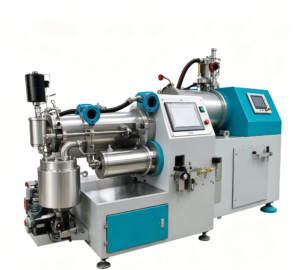
The horizontal pin-type nano bead mill is more than just grinding equipment—it is a core tool for improving material dispersion, reducing particle size, and ensuring stable product quality. Its combination of high grinding energy, precise temperature control, low contamination, real-time monitoring, and flexible scalability makes it an ideal choice for lithium battery slurry, electronic ceramic, pharmaceutical nanoparticle, and advanced material research.
For laboratories and production teams working on high-performance nano materials, selecting the right bead mill can significantly improve experimental repeatability, reduce process development time, and lay a solid foundation for scale-up.
If you would like technical specifications, material testing recommendations, or information on custom configurations, please contact Suzhou 023 Intelligent Equipment Co., Ltd.