Many new researchers have reached out to me lately, asking: when conducting co-precipitation synthesis of nickel ternary precursors or layered oxides for sodium-ion batteries, apart from formulation design itself, what equipment factor exerts the greatest impact on material performance?
My answer is always the same: the micro hydrodynamics and constant environmental precision inside the reactor.
As a technical liaison engineer at Suzhou 023 Intelligent Equipment Co., Ltd. located in Suzhou Industrial Park, I tackle numerous R&D pain points encountered by university labs and new energy enterprises on a daily basis. Most researchers only care whether a reaction can proceed, yet overlook the critical factor of precise process control.
Today, I will cut through empty talk and discuss the core technical thresholds of co-precipitation reactors from a process perspective, as well as how our equipment innovations eliminate technical roadblocks for R&D personnelw.
I. Why Is the Morphology of Your Synthesized Materials Always Undesirable?
All engineers working on cathode material precursors (high-nickel ternary, lithium iron phosphate, lithium-rich manganese-based, etc.) know that the core of the co-precipitation method lies in supersaturation control.
Many laboratories start synthesis with simple glass vessels or basic stainless steel reactors, only to encounter the following issues:
- Severe pH fluctuations: Alkali solution is added manually or via basic peristaltic pumps with significant response lag, resulting in a broad particle size distribution (PSD).
- Uneven stirring: Dead zones exist inside the reactor with localized over-concentration, generating fine powders and even impurity phases.
- Inadequate inert atmosphere protection: Oxidation of oxidation-prone elements (e.g., divalent iron, manganese) darkens precursors and completely ruins their electrochemical performance.
This explains why experiments yield ideal results in beakers but fail drastically when scaled up to reactors. Fundamentally, the problem stems from insufficient equipment performance rather than flawed formulations.
II. Core Performance Standards of a High-Quality Co-Precipitation Reactor
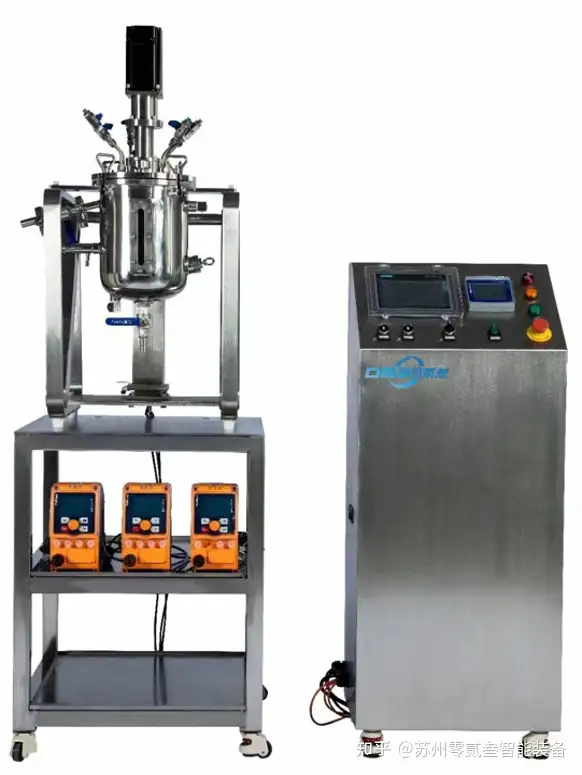
When designing our PR-series co-precipitation reactors (1L to 500L), Suzhou 023 Intelligent Equipment centers its design philosophy on process stability and traceable experimental data.
We have implemented targeted optimizations to address the above pain points:
1. Fully Automatic Closed-Loop PLC Precision Control (True Autopilot Function)
Many reactors claim PLC integration yet only support basic data display.
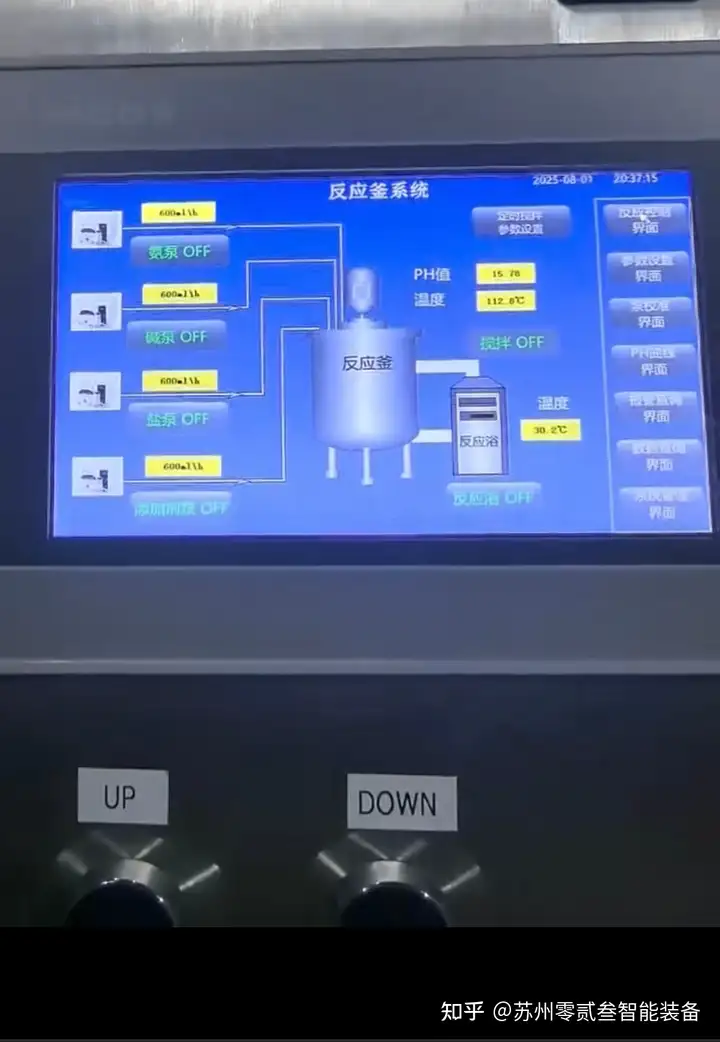
Our system achieves full logic closed-loop control: after you set a target pH value (e.g., 11.00), high-precision Mettler Toledo pH electrodes deliver real-time feedback, and the system automatically adjusts the rotational speed of peristaltic/metering pumps.
Actual performance: pH fluctuation is limited within ±0.01, far more accurate than manual operation. This precision is indispensable for synthesizing spherical precursors with uniform particle sizes.
2. Powerful Servo Agitation for Homogeneous Mixing
High-nickel material systems (NCM811, NCA, etc.) feature high slurry viscosity; insufficient agitation causes elemental segregation.
We adopt magnetic coupling seals or mechanical seals paired with dual-layer propeller/paddle agitators, supporting a maximum rotational speed of 1500 RPM. Even for 5L and 10L pilot-scale reactors, no dead zones remain inside the vessel, enabling synchronized crystal nucleation and growth.
3. Material Selection & Customization: Minor Details Determine Experimental Success
- Materials: The reactor’s material contact surface is made of 316L stainless steel, with the jacket constructed from 304 stainless steel and an inner wall with mirror polishing. Polishing quality is critical—rough inner walls cause severe material adhesion and extreme cleaning difficulty.
- Customization: Process requirements differ greatly between sodium-ion battery and ternary material synthesis. We provide non-standard customization covering reactor height-diameter ratio, feeding modes, and agitator configurations tailored to your unique process parameters.
III. Our Product Line: Engineered Exclusively for Lithium & Sodium Battery Research
Now let’s introduce our flagship product. If you are sourcing a co-precipitation reactor for lithium/sodium-ion battery precursor synthesis, our PR-series from Suzhou 023 Intelligent Equipment is well worth your consideration.
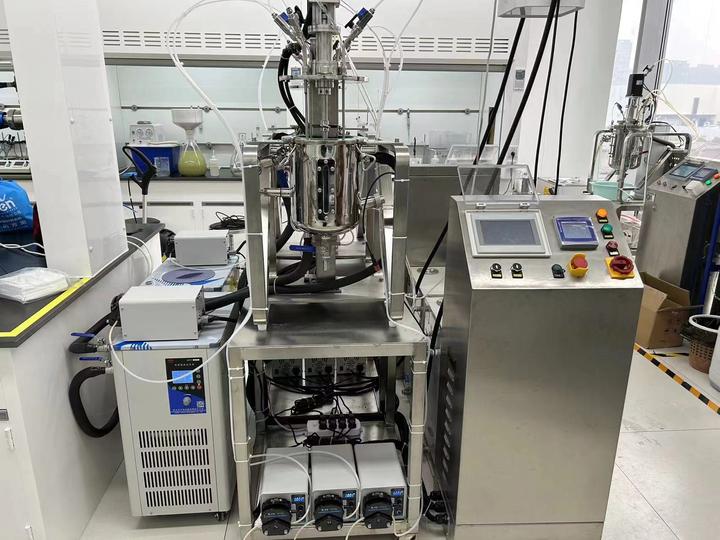
Far more than a simple reaction vessel, it is a complete integrated reaction system:
Core Application Scenarios
Ideal for laboratory research, lab-scale trials and pilot production of high-nickel ternary precursors, layered sodium-ion oxides, lithium-rich manganese-based materials, and solid electrolytes (e.g., LLZO).
Full-Process Real-Time Monitoring
The system automatically records feeding rate, temperature, pH value, and stirring torque. All batch experimental data is traceable and exportable—an essential function for researchers requiring solid data support for academic papers.
One-Stop Engineering Support
We possess mature engineering expertise to validate process scaling from 1L lab-scale exploration to 100L pilot trials. Many clients report excellent linear fitting consistency between small-scale reactor data and mass production parameters, a testament to our superior equipment performance.
Practical Application Case Study
One client developing layered sodium-ion oxides obtained prominent impurity peaks in XRD tests using equipment from other suppliers. We ran their synthesis process on our 5L PR reactor: precise nitrogen inert protection eliminated oxidation, and accurate pH control delivered pure-phase materials in a single trial run. The client joked, “Switching to this reactor made the perfect product.”
IV. Reactor Selection Tips & Pitfall Avoidance Guide
Below are practical suggestions for researchers sourcing co-precipitation equipment:
- Do not prioritize low prices: Cheap reactors from small manufacturers often suffer poor air tightness, a fatal flaw for anaerobic material synthesis.
- Prioritize after-sales service: Co-precipitation experiments often run continuously for dozens of hours. Equipment stability and fast manufacturer support are critical. Headquartered in Suzhou, we operate a complete supply chain and dedicated after-sales team.
- Request actual test interfaces before purchase: Ask suppliers to provide screenshots of real control panels to verify true automatic PID control, instead of semi-automatic systems.
For new energy material R&D, high-performance equipment is your most vital tool. At Suzhou 023 Intelligent Equipment Co., Ltd., we strive to develop the most reliable reaction equipment for researchers worldwide.
If you encounter bottlenecks in co-precipitation processes or are currently selecting reactors, feel free to send private messages or leave comments for technical exchanges. We offer customized process packages for various material systems (high-nickel, cobalt-free, sodium-ion batteries). You are welcome to bring your samples to our Suzhou facility for free testing!
Hit the like button if this guide helped you—your support motivates me to share more professional industry insights!